
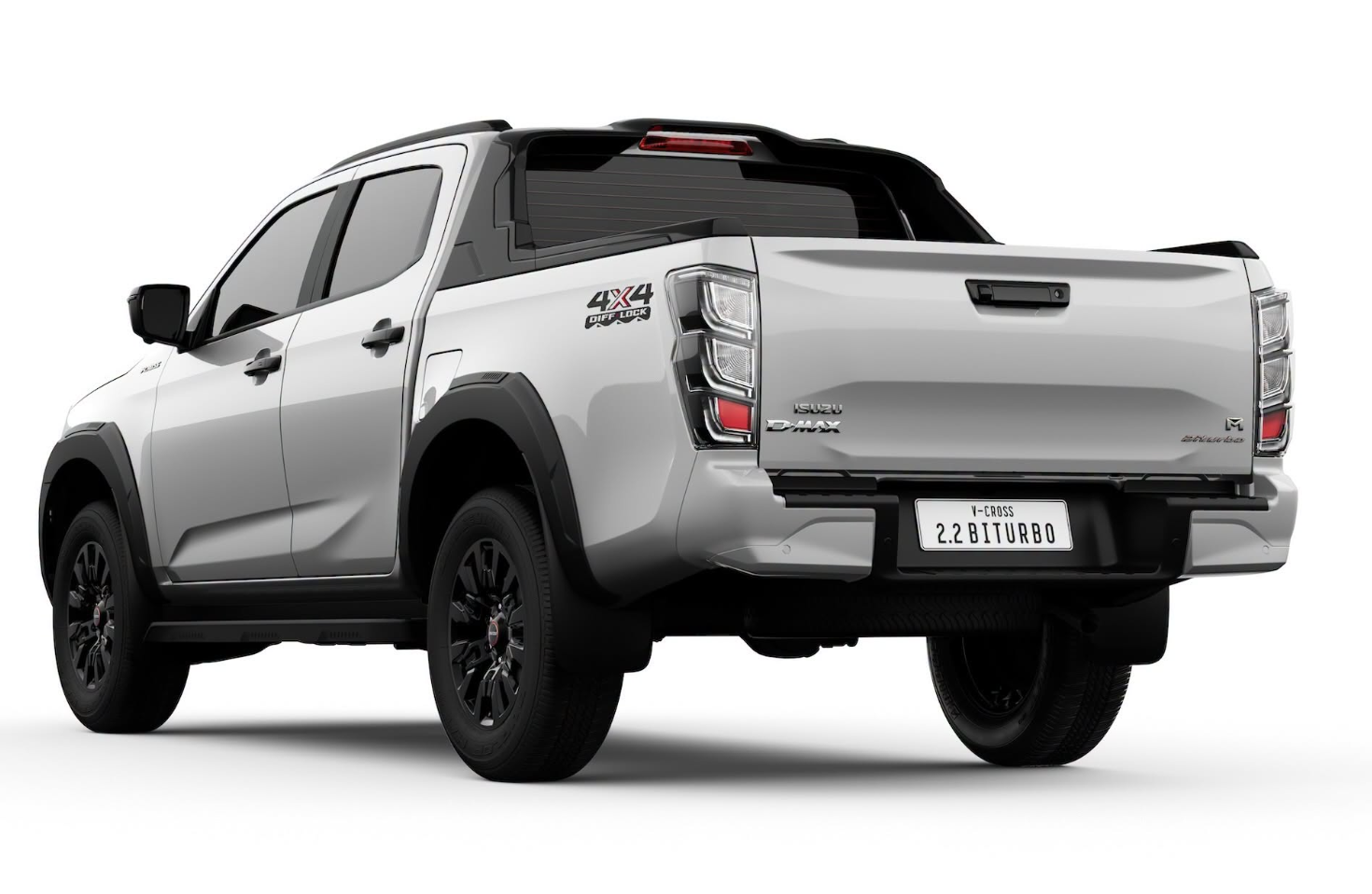
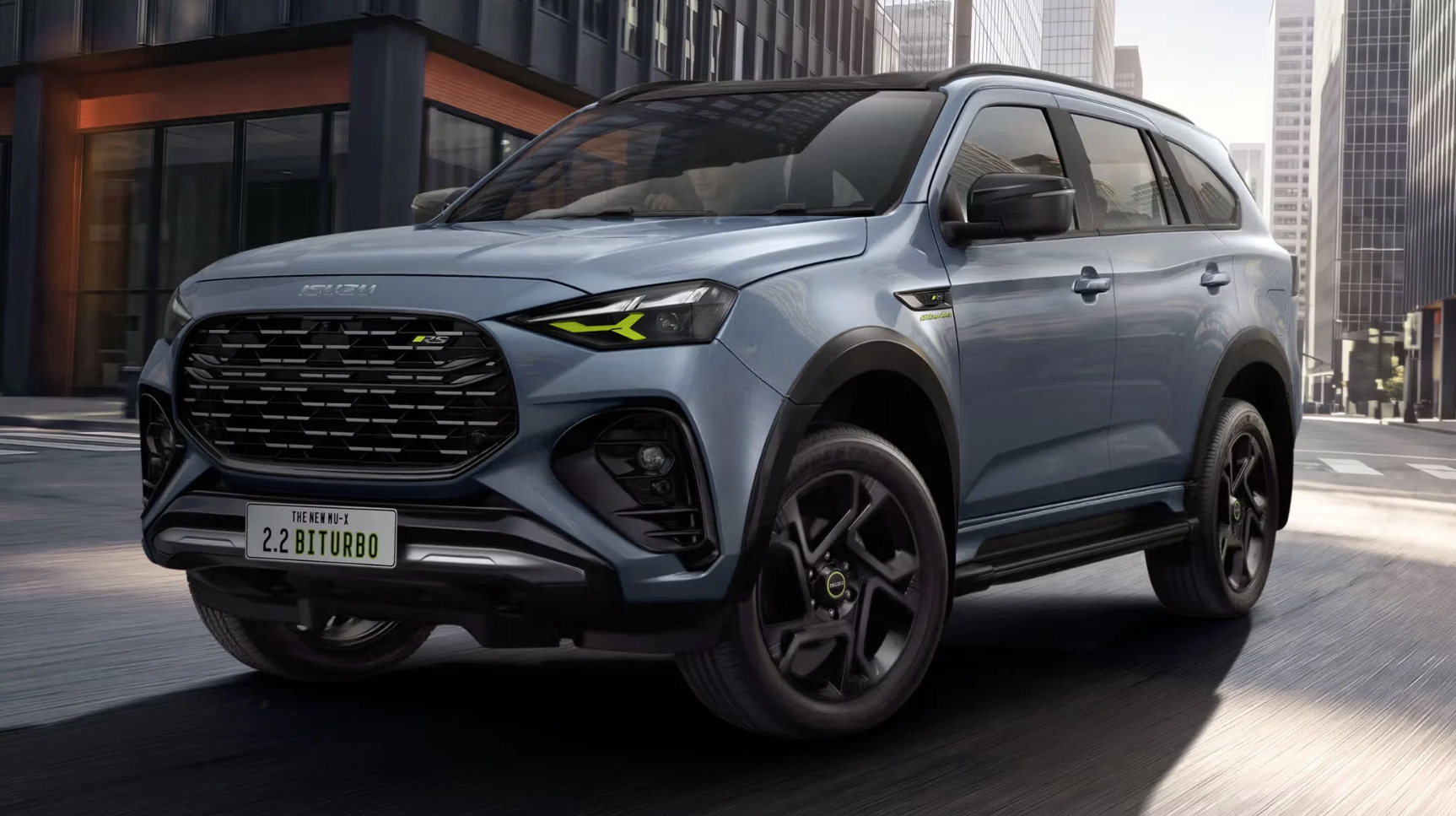
Isuzu has unveiled a new 2.2-litre bi-turbo diesel as part of the reveal of updated D-MAX and MU-X models in Thailand, but whether the engine will reach Australia remains unconfirmed.
The new Ddi Maxforce Bi-Turbo produces 150kW and 500Nm, exceeding the Australian-market 3.0-litre diesel’s 140kW and 450Nm. It also outguns the existing single-turbo 2.2-litre, which delivers 120kW and 400Nm. The smaller engine could give Isuzu another option as Australia’s New Vehicle Efficiency Standard (NVES) tightens, although its impact on fleet emissions would depend on its efficiency and whether it joins the local range.
Isuzu claims the bi-turbo accelerates five per cent quicker from 0-100km/h than the 3.0-litre and improves extra-urban fuel efficiency by eight per cent. It uses a two-stage turbocharging system and is paired with a revised eight-speed automatic, while selected Thai-market D-MAX variants also offer a six-speed manual.
Could the 2.2-litre replace the 3.0-litre?
The new engine offers a potential middle ground between Isuzu’s existing diesels, delivering more power and torque than the 3.0-litre despite its smaller capacity.
However, peak outputs alone won’t establish whether it can match the larger engine’s appeal among Australian owners who tow and tour. Real-world fuel consumption, performance under load and long-term durability will be important considerations if it reaches local showrooms.
The announcement follows Isuzu’s decision to cancel plans to bring the all-electric D-MAX EV to Australia, leaving diesel as the brand’s only powertrain option locally for now. If introduced here, the new bi-turbo could offer another way to address emissions without moving away from diesel.
As mentioned, the engine was revealed alongside facelifted D-MAX and MU-X models in Thailand, which receive revised exterior styling. Isuzu Ute Australia has not confirmed plans to introduce the new engine or the updated models locally. For now, the 3.0-litre remains in the Australian range.
Isuzu bi-turbo diesel: quickfire FAQs
What is Isuzu’s new 2.2-litre diesel?
It’s a twin-turbo diesel unveiled for updated D-Max and MU-X models in Thailand.
How much power does it produce?
The engine delivers 150kW and 500Nm.
Will it come to Australia?
Isuzu Ute Australia has not confirmed local availability.
Is it more fuel-efficient than the 3.0-litre?
Isuzu claims an eight per cent improvement in extra-urban fuel efficiency.
Is the 3.0-litre diesel being discontinued?
No discontinuation has been announced, and the new engine’s role in the Australian range remains unclear.
Throttle controllers are nothing new to the four-wheel drive scene.
We’ve been using them for years to tailor throttle response to suit how and where we drive. They have proven especially beneficial on turbo-diesel vehicles, where accelerator calibration can add to the feeling of turbo lag. A throttle controller will usually have multiple modes to alter how accelerator-pedal inputs translate into throttle response, making the vehicle feel more responsive.
Throttle controllers do not increase engine power or torque, nor do they eliminate turbo lag itself. They simply alter how the engine responds when you put your foot down on the accelerator. And that’s pretty much all they do – until now.
More than a throttle controller
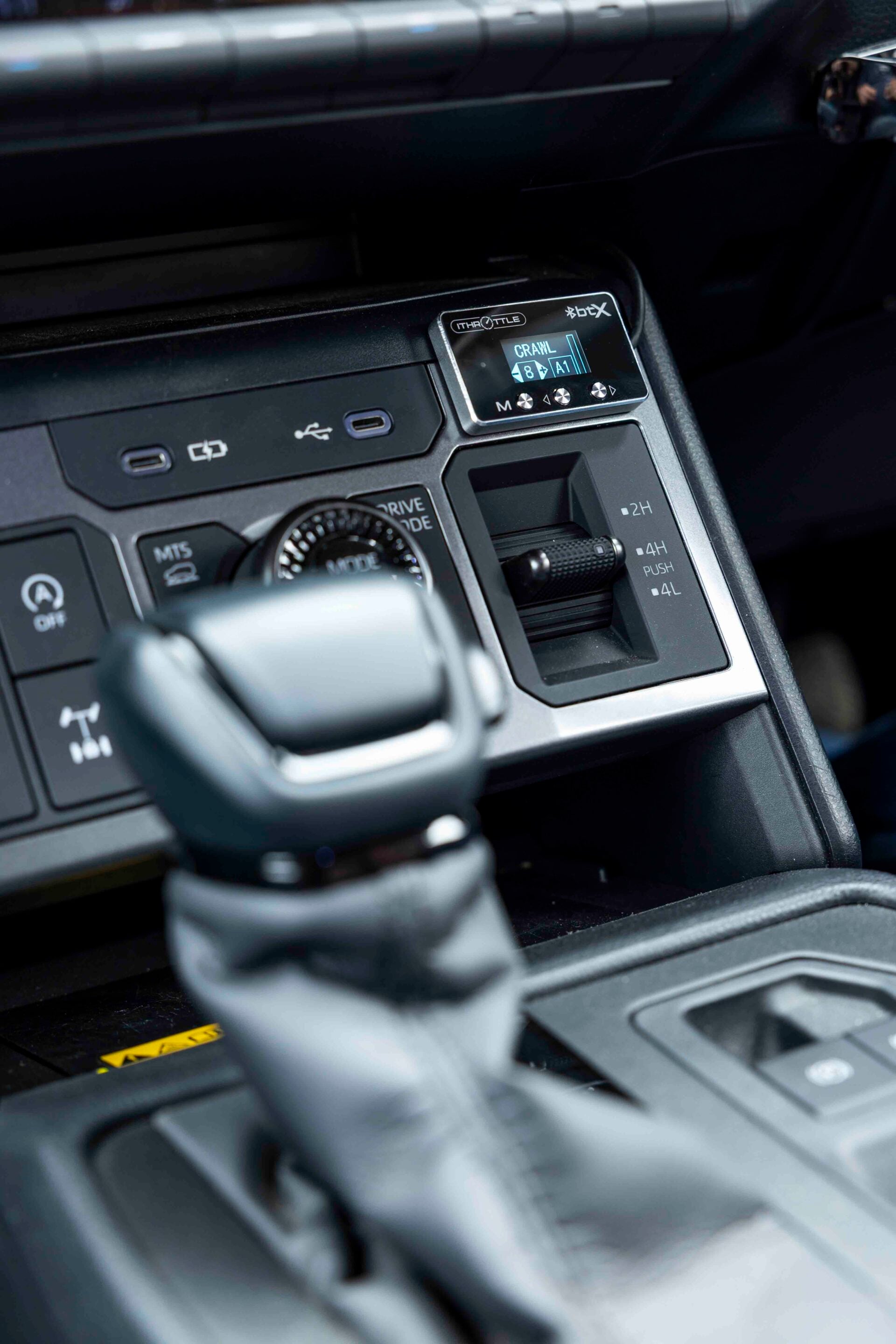
The Australian-developed iThrottle BTX control unit (↗) does everything throttle controllers have done in the past but adds a host of useful functions, such as a winch mode and throttle disabler, all in one unit.
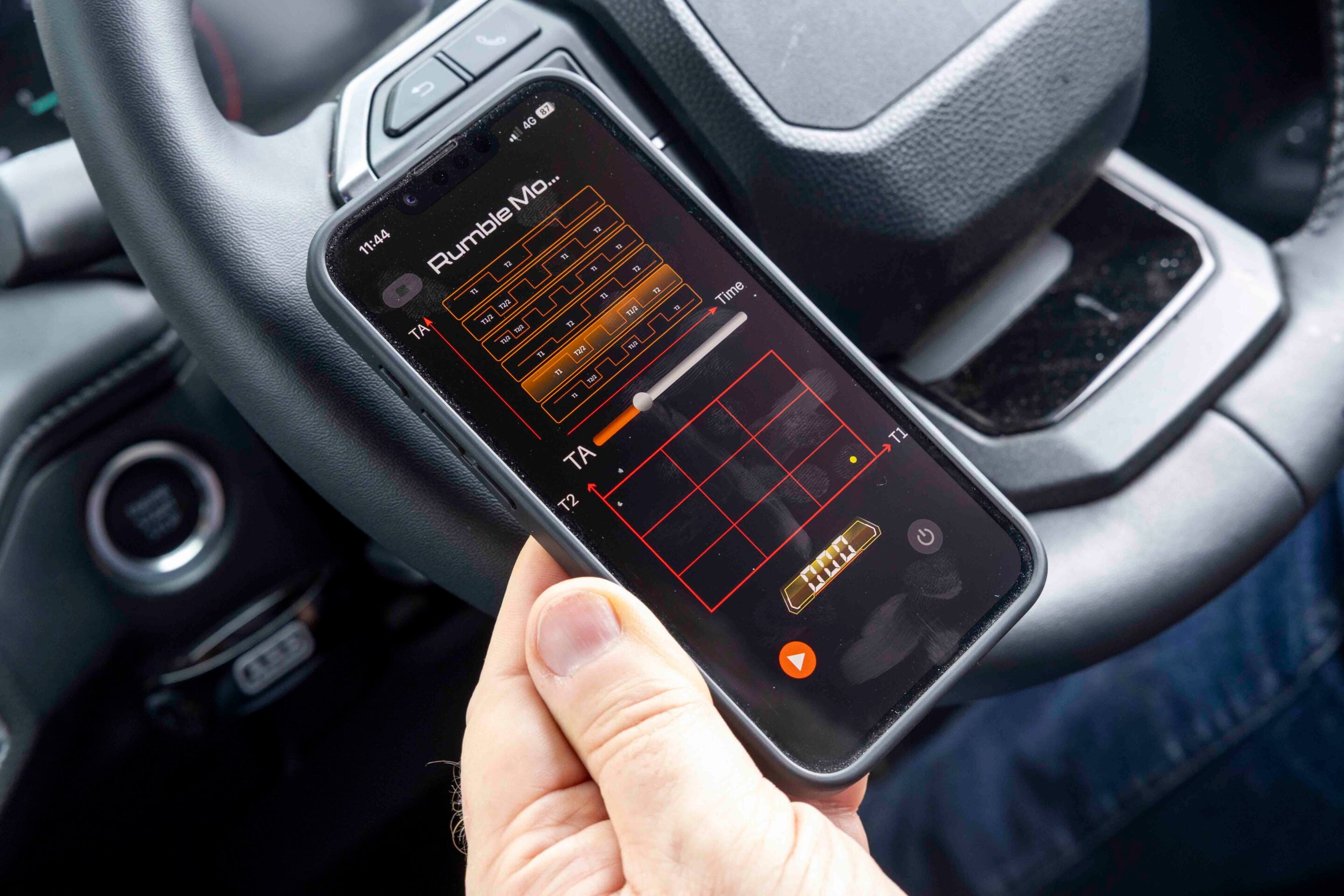
It offers drivers nine stages of calibration to either sharpen response for performance or soften it for smoother control when driving off-road. Like the selectable drive modes built into most modern four-wheel drives, the iThrottle has preset modes for towing, sand driving and rock crawling, which can be further adjusted to suit your needs. The last thing a driver wants is an overly sensitive accelerator when bouncing over rocks or rough terrain, so the modes for those conditions soften the response to accelerator inputs.
Modes can be selected by scrolling through the menu on the iThrottle screen. For added convenience, all functions can also be controlled using the iThrottle phone app. With your phone mounted in a secure holder, you can select modes by tapping the onscreen buttons or adjust sensitivity using the slider.
Extra features: Winch mode, immobiliser and diagnostics
If your four-wheel drive has an electric winch fitted, you’ll know the benefits of keeping the engine revs up while using it.
This can increase the alternator’s output, helping support the battery while the winch draws a heavy electrical load. Winch mode allows you to set and hold the engine speed for the duration of the winching operation. It’s a simple and clever addition to the iThrottle unit (↗).
Another clever function is the SmartLock pedal immobiliser. As the name suggests, SmartLock disables the accelerator pedal when you leave the car, and it can only be reactivated once you enter a code you’ve set yourself. Again, this uses the factory hardware, with the iThrottle able to disable the accelerator pedal once you’ve set up the feature in the app. For further theft protection, iThrottle Australia also sells locks to prevent unwanted access to the car’s OBD port.
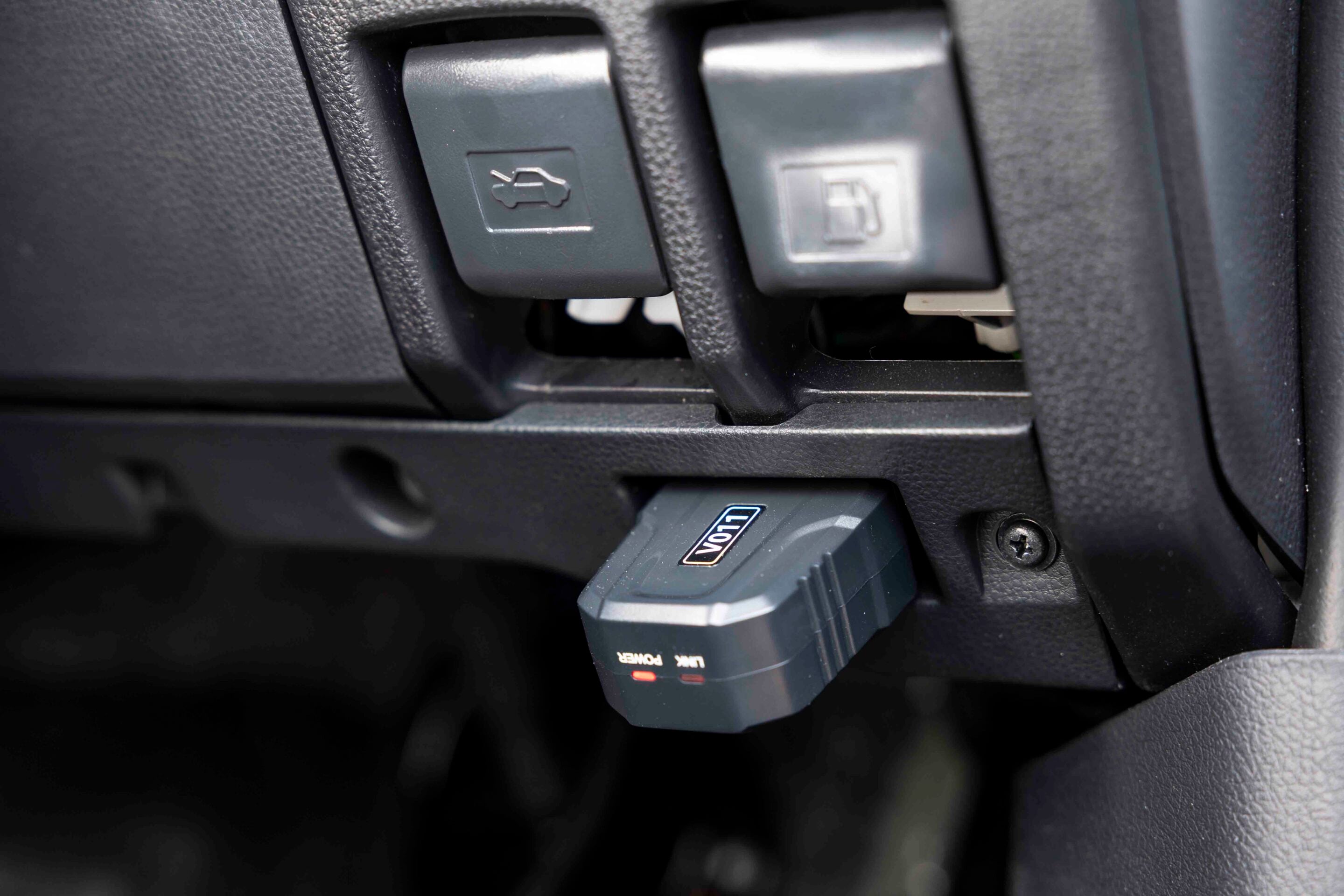
The functionality and reassurance of an OBD scan tool and diagnostic aid can also be added to the iThrottle app with the optional OBD Tool. This dongle plugs into the vehicle’s OBDII port and connects to the app via Bluetooth, allowing you to scan for engine fault codes, find out what they mean and clear them if needed.
Many travellers consider an OBD scanner essential equipment when touring the country. Adding this option to your iThrottle means you don’t need a separate standalone scanner, with the information accessible through the iThrottle app on your phone.
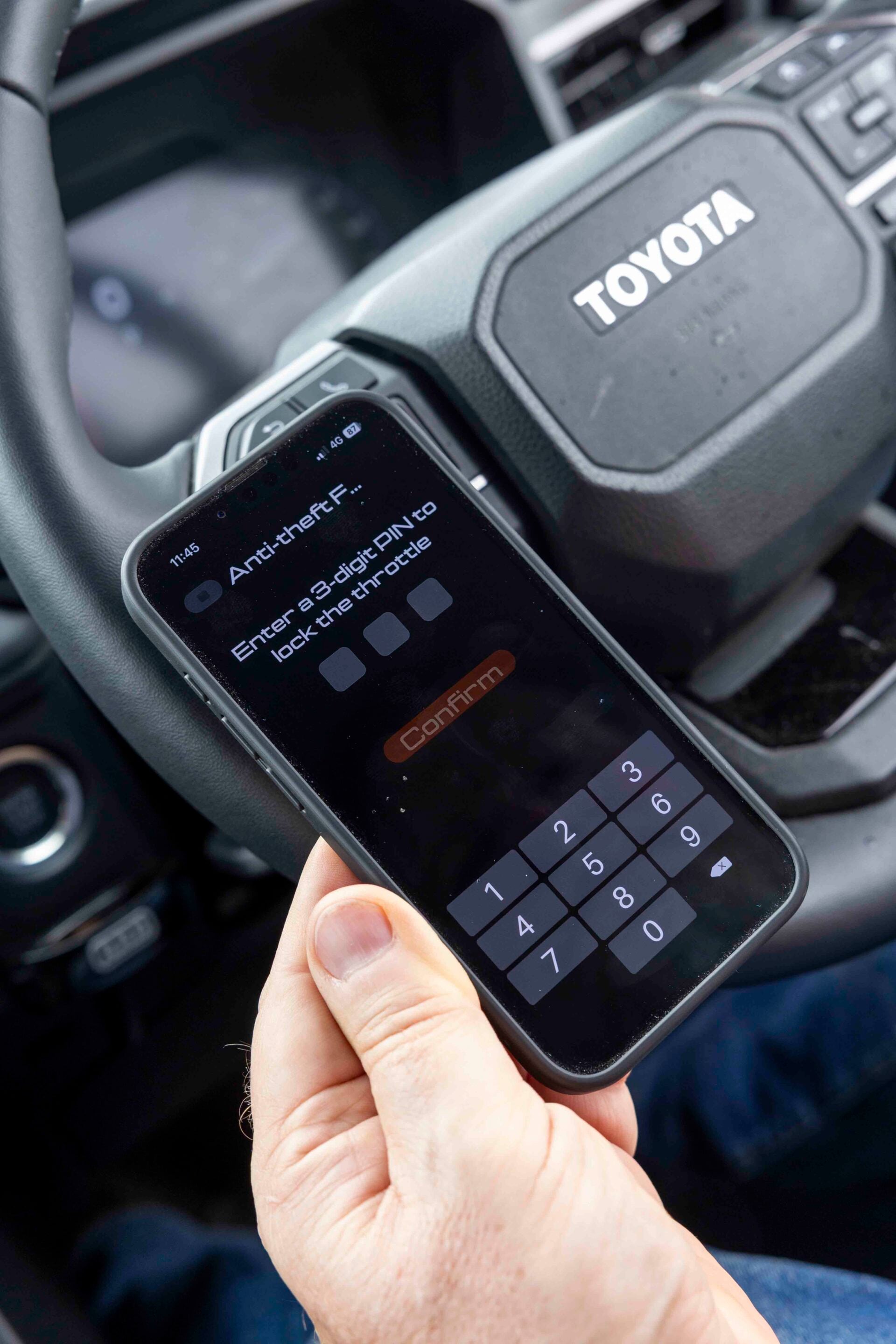
iThrottle BTX tested on our 2026 HiLux
We fitted the iThrottle BTX controller and OBDII reader to our 2026 HiLux to see how well they work.
It’s a relatively simple plug-and-play installation. Once fitted and linked to my phone via Bluetooth, we explored the settings, checked out the modes and tested the winch and immobiliser functions before hitting the road. The immobiliser won’t prevent thieves from getting into your car or starting it, but it disables the accelerator pedal so they can’t use it.
On the road, we switched between the different modes, and you can certainly feel the difference between them. Position 1 on the slider softens throttle response, and the ‘Crawl’ mode has a similar effect, while position 9 sharpens it up with an immediate response to even light pedal inputs. Off-road and in low range, we selected ‘Crawl’ and let the ’Lux idle through the melon holes, applying minimal throttle when needed. It was certainly easier to control than with the factory Toyota calibration.
We’ve since tried a few different settings for general driving but have settled on the ‘Intelligent’ mode, which monitors your driving and adapts the setting to suit your style. I’ve found this works well for day-to-day on-road use.
Verdict
The iThrottle unit (↗) works just like other throttle controllers on the market in terms of throttle feel and calibration, but it’s the extra features that make it better than the others and worth considering even if you already have a controller.
The built-in drive modes, winch mode and immobiliser function are all clever, useful features that broaden the controller’s capabilities. Add the OBD Tool and you can also read fault codes without having to find a workshop or carry a separate standalone scanner. It’s a clever Australian concept that has been well executed in the iThrottle unit.
iThrottle BTX FAQ
How much does the iThrottle BTX cost?
The iThrottle BTX throttle controller has an RRP of $345.
How much does the iThrottle OBDII Scan Tool cost?
The optional OBDII Scan Tool costs $125.
What features does the iThrottle BTX offer?
Features include adjustable throttle response, preset driving modes, winch mode and a SmartLock pedal immobiliser.
Is the iThrottle BTX worth buying?
Its extra features, including winch mode, pedal immobilisation and optional engine diagnostics, make it worth considering even if you already have a throttle controller.
Where can I buy the iThrottle BTX?
Visit the iThrottle Australia website (↗) for more information.
The legendary Mitsubishi Pajero is making its comeback before the end of the year with a new vehicle using a body-on-frame design, unlike the monocoque Pajeros of the last generation. That chassis is derived from the one under the current Triton ute, as is the four-cylinder diesel engine.
Five- and seven-seat variants will be available in local showrooms from December 2026, with the five-seat GLS priced at $68,490, the seven-seat GLS at $69,990, the seven-seat Exceed at $79,990 and the seven-seat GSR topping the range at $84,990 (all RRP).
The important news is what sits underneath. Every Pajero gets a dual-range transfer case, rear differential lock and Mitsubishi’s Super Select 4WD-II system, with 3500kg of braked towing capacity. So you don’t need to step up to the higher-spec models to get the important off-road hardware.
Off-road performance
Our first taste of the new Pajero was in pre-production models at a four-wheel drive park in South Australia. We didn’t turn a wheel on bitumen and rarely saw more than 25-30km/h, so it was hardly a thorough evaluation.
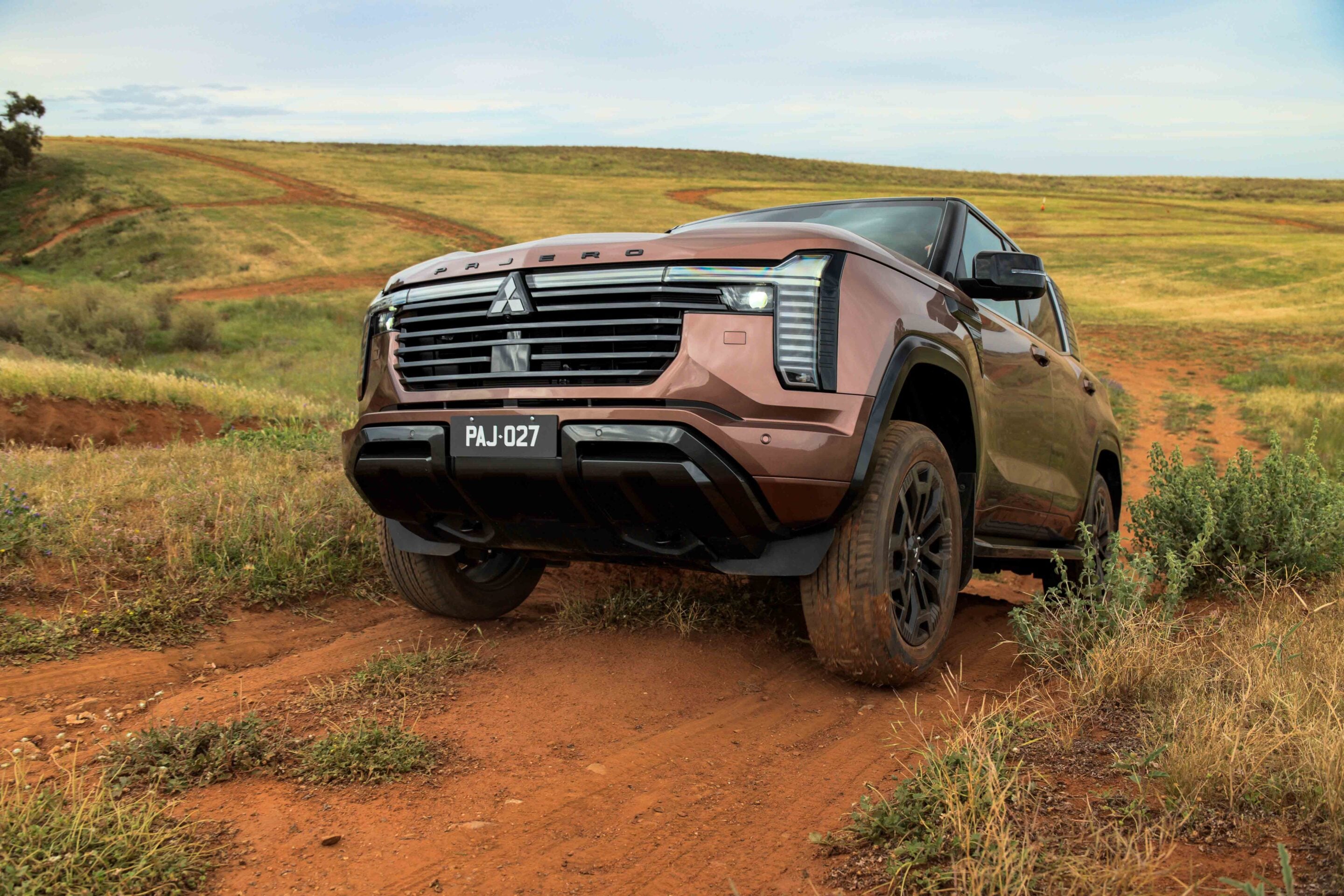
But on the evidence of the dirt, this is the most convincing Mitsubishi in more than a decade (maybe two!) – and a giant leap for the Pajero nameplate. It takes a genuine step forward in off-road ability and an even bigger one in comfort and refinement.
We didn’t get the chance to experience the engine’s full fury, but what we did sample impressed. Throttle response is well measured, nicely calibrated for feeding in power over rocks and up steep pinches, and it works well with the eight-speed auto.
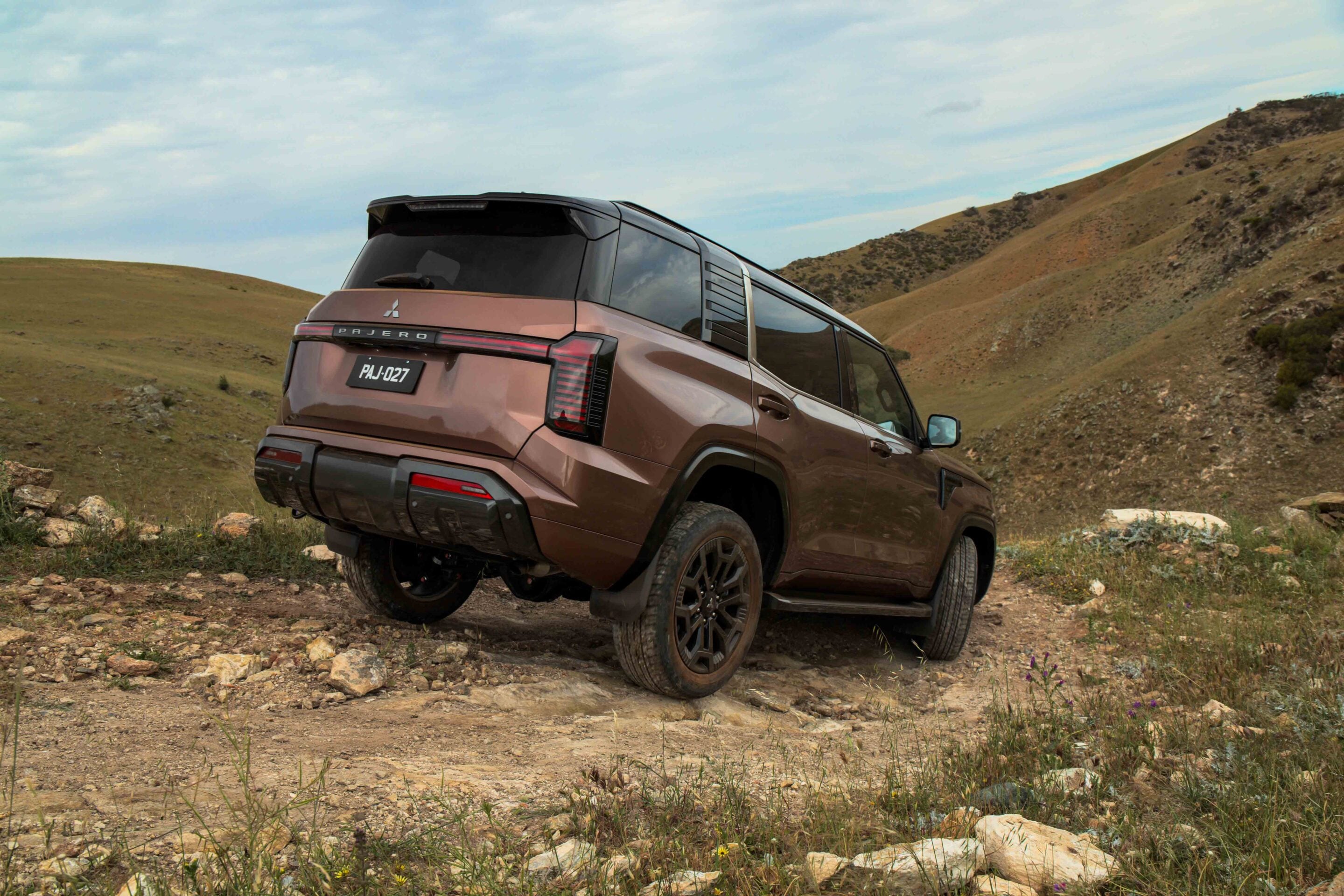
Arguably the biggest improvement is in refinement. The old Pajero – as loveable as it was – could get raucous, whereas the new one is quiet and smooth. It’s also noticeably more refined than the Triton, which uses a twin-turbo version of the same engine.
More ratios also bring benefits. First gear is shorter, something that pays off with engine braking on descents. While you’ve still got hill descent control as an electronic aid, you’re less likely to need it or to brush the brakes than in the previous car.
While the independent suspension and monocoque setup worked surprisingly well in the previous Pajero, the new one’s nod to tradition – a ladder frame with a live rear axle – steps things up considerably. There’s less chance of scuffing the metal underbody protection over rocks.
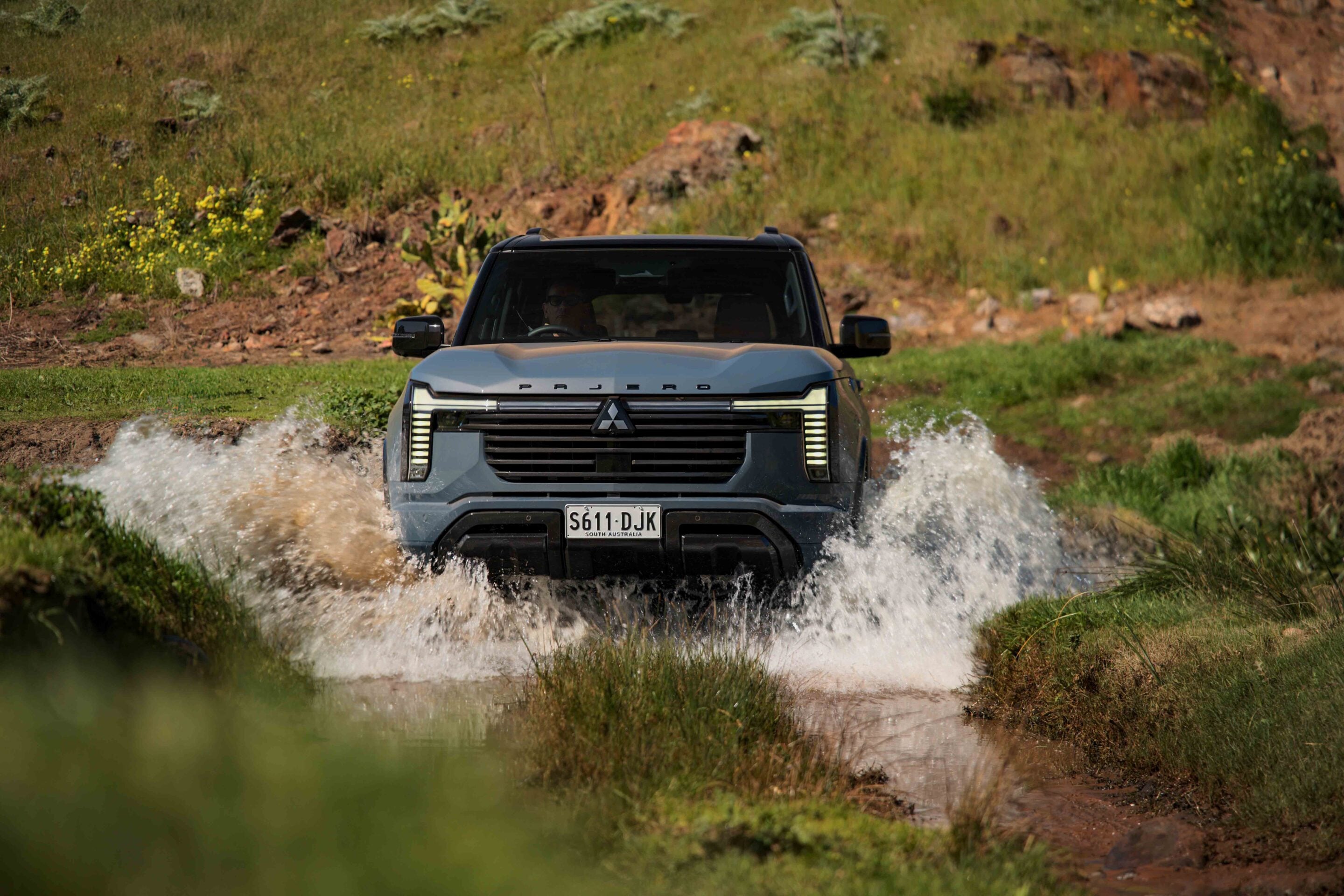
Wheel articulation has also headed in the right direction; the rear end in particular droops and compresses far more than the old Pajero’s, keeping tyres planted where the previous car would be lifting a wheel and scrabbling. In short, you’re less likely to need electronics because there’s more real traction to play with.
You can argue about the need for a 2H setting (Toyota doesn’t bother in the Prado), but Mitsubishi’s Super Select is as good as ever, with 2H, 4H, 4H Lock and locked low range. Pair that locking centre diff with a rear locker and there’s supreme traction. The traction control generally worked well, but on one cross-axle climb it couldn’t quite sort things out in the auto mode we’d left it in. Lock the centre and rear diffs, though, and the Pajero walked through without fuss.
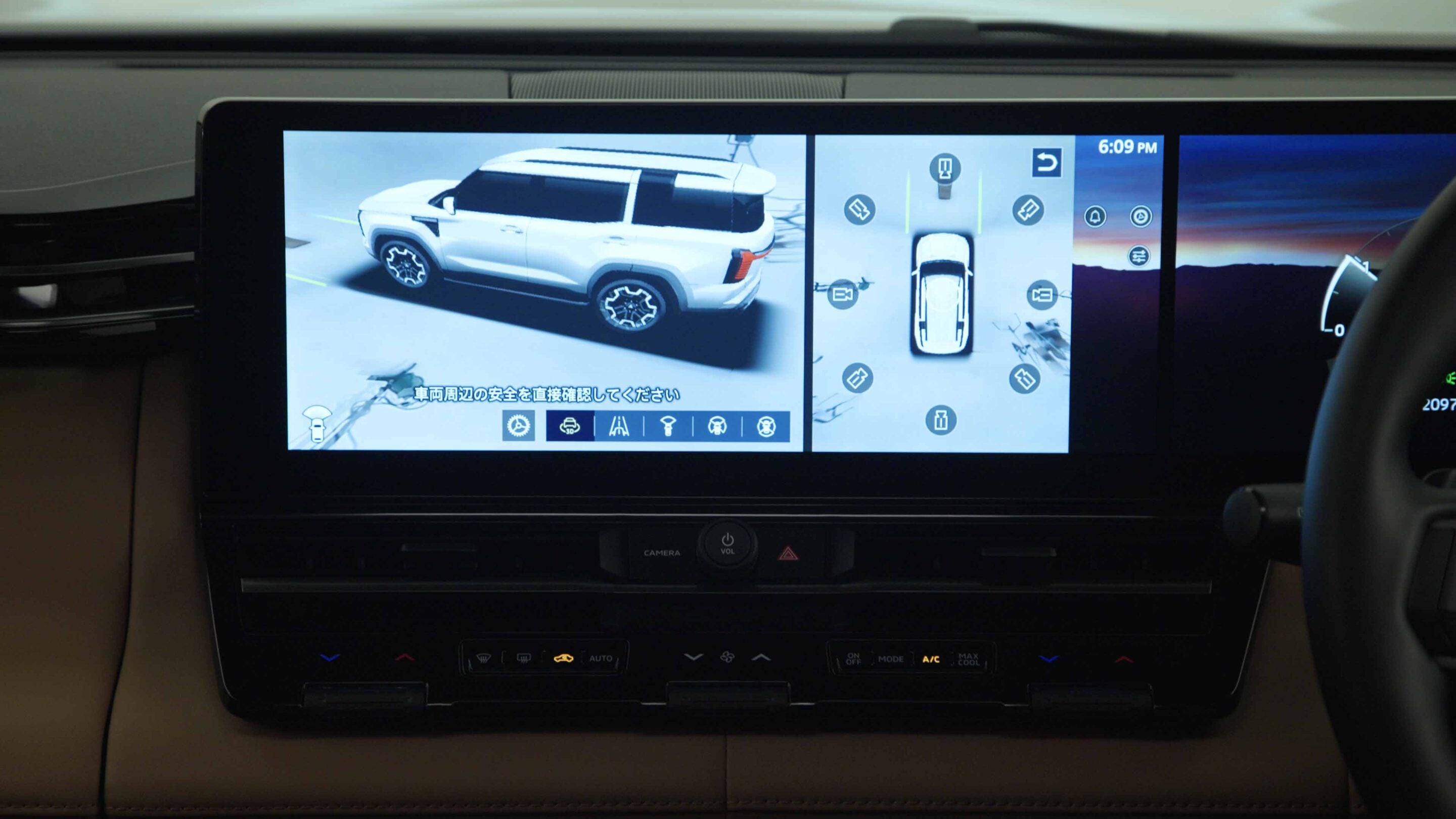
If there’s one complaint, it’s forward vision; that bulky bonnet makes it trickier to place the front wheels on rocky climbs. Thankfully, technology helps, with the 360-degree camera and see-through bonnet system providing some digital visibility of what’s going on up front.
Electric power steering replaces the old hydraulic setup – and, as with the HiLux, Prado and others, the change is a revelation, making for far easier manoeuvrability. It’s lighter and requires fewer twirls to get the job done.
Interior and refinement
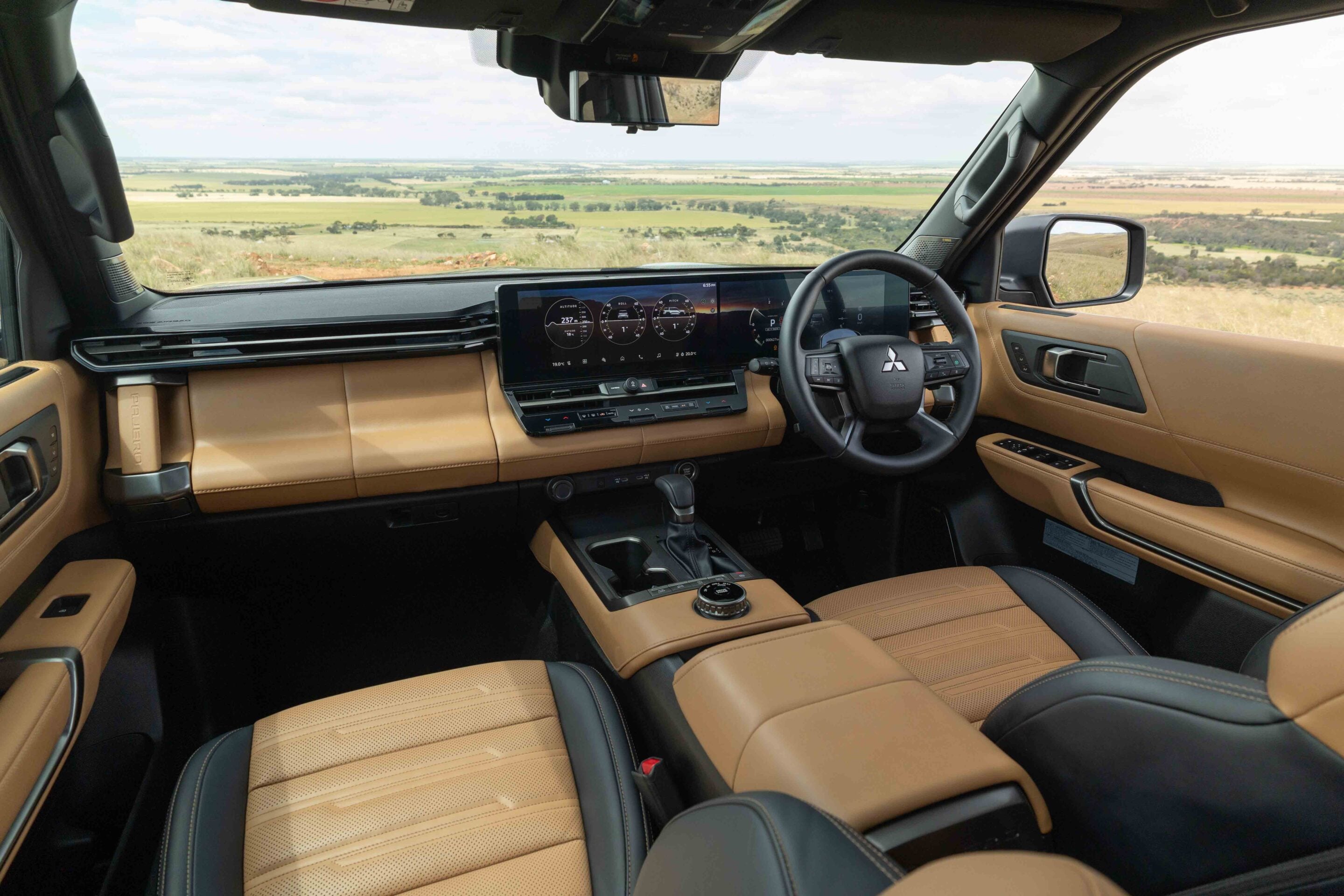
Inside, the leap in the Pajero world is enormous. This is an off-roader that pampers.
It’s impressively quiet and refined, and the finishes, materials and modern pixel-infused layout are a big step beyond any other current Mitsubishi. It feels roomier than the photos suggest, too. Grab handles on each A-pillar and either side of the dash are handy for bracing yourself in the rough stuff or climbing aboard.
A digital instrument cluster flows into the central screen, and there’s a proper volume knob (hooray!). The iconic Mitsubishi multimeter has survived the digital transition, now as a screen showing your choice of three of six readouts: pitch, roll, compass, altitude, clock and Active Yaw Control. It’s handy, but it takes over the whole centre display and lacks the charm of the old dash-top gauges.
There’s a 150-watt household outlet in the second row (enough for a fridge or some lights, but not a kettle or toaster) and a 12-volt socket plus USB-C ports in the third row. The dual glovebox adds to the hidey-holes you can stuff things into.
When it comes time to clean out an air filter or check the fluids, there are gas struts to prop the bonnet up – a small detail that reflects the effort Mitsubishi has put into the new Paj. And, as with the Prado, the swing-out tailgate is gone in favour of a lift-up door, which means the full-size spare is now hidden underneath.
Engine and powertrain
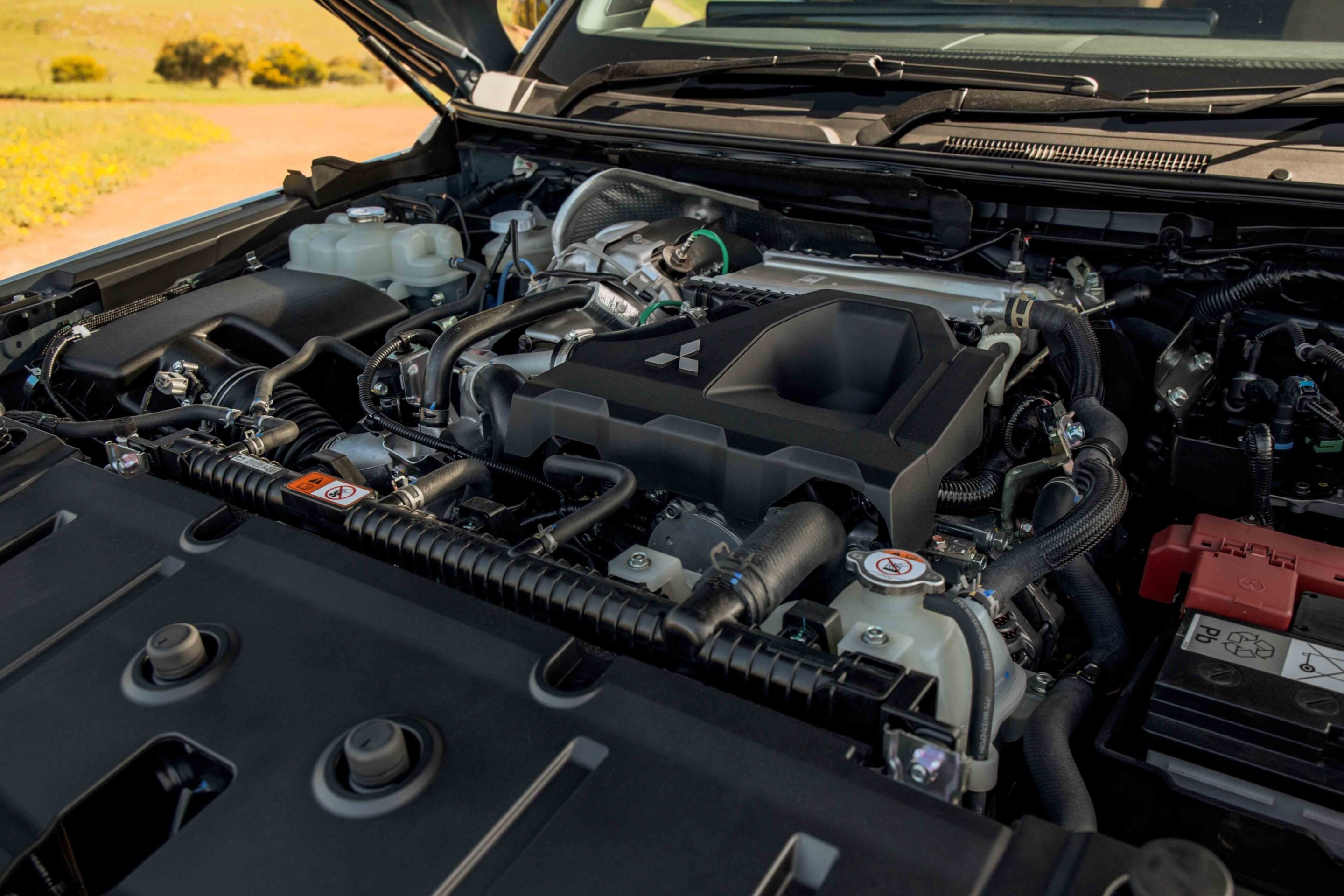
The engine is the latest-generation version of Mitsubishi’s 4N16 2.4-litre four-cylinder diesel and produces 150kW and 480Nm, with a variable-geometry turbocharger in lieu of the twin turbos used in other applications.
Peak torque has increased by 10Nm over the previous application, while the new turbocharger is designed to improve midrange response, which should be useful for low-speed off-road driving and towing. The Pajero has a 3500kg braked towing capacity.
The engine uses a water-cooled intercooler, dual-loop EGR and AdBlue to meet Euro 6d emissions standards. Power is sent through an eight-speed automatic transmission to the Super Select 4WD-II transfer case.
Verdict
Add it all up, and on rough roads the new Pajero makes a sizable leap in the right direction.
Where the Triton felt like Mitsubishi simply adding another ute to the pile, the Pajero feels like the result of a company trying hard to unseat established rivals such as the Prado, Everest and MU-X while taking on the tsunami of new brands entering the 4×4 wagon market. The opposition is tough, but our first taste of the new Pajero suggests this is Mitsubishi back near its best.
The new Pajero will be launched in Australia in December, and we’ll have a full on- and off-road review for you then.
Model range and pricing
| Model | Seats | RRP |
|---|---|---|
| Pajero GLS | 5 | $68,490 |
| Pajero GLS | 7 | $69,990 |
| Pajero EXCEED | 7 | $79,990 |
| Pajero GSR | 7 | $84,990 |
Safety features
Passive safety
- Driver and front passenger front and side airbags
- Front centre airbag
- Driver knee airbag
- Curtain airbags for first and second rows
- Third-row curtain airbags on seven-seat models
- Three second-row child restraint anchor points
- ISOFIX child-seat mounting points
Active safety and driver assistance
- MiPilot adaptive cruise control with Lane Keep Assist
- Leading Car Departure Notification
- Minimum Risk Manoeuvre
- Traffic Sign Recognition
- Intelligent Speed Limiter
- Automatic Post-Collision Braking
- Emergency Call System
- Forward Collision Mitigation with pedestrian and cyclist detection
- Predictive Forward Collision Mitigation
- Rear Autonomous Emergency Braking
- Blind Spot Warning and Lane Change Assist
- Emergency Lane Assist
- Lane Departure Warning and Lane Departure Prevention
- Emergency Assist for Pedal Misapplication
- Front and rear parking sensors
- Multi Around View Monitor
- Bonnet see-through camera
- Front and rear Cross Traffic Alert
- Driver Attention Alert
- Driver Monitor System
- Child Presence Detection
- Automatic High Beam
- Active Yaw Control
- Active Stability Control
- Anti-Lock Braking System
- Active Traction Control
- Electronic Brakeforce Distribution
- Brake Override System
- Trailer Stability Assist
- Hill Start Assist
What do you get?
Pajero GLS
- 2.4-litre 4N16 turbo-diesel | 150kW/480Nm
- Eight-speed automatic
- Super Select 4WD-II
- Rear differential lock
- Seven drive modes
- 3500kg braked towing capacity
- 18-inch alloy wheels with 255/65R18 Mud and Snow tyres
- Five- or seven-seat configuration
- Waterproof black fabric seats
- 12.3-inch digital instrument cluster
- 12.3-inch multimedia display
- Wireless Apple CarPlay and Android Auto
- Wireless phone charger
- Mitsubishi CONNECT
- Dual-zone front and automatic rear air conditioning
- Electric tailgate
- Comfort and convenience
- Heated steering wheel
- Keyless entry and push-button start
- Electric park brake with auto-hold
- Rain-sensing wipers
- Auto-dimming rear-view mirror
- Privacy glass
- LED headlights, fog lamps and DRLs
- Black roof rails
- Grey side steps
- Black wheel-arch mouldings
Pajero EXCEED
In addition to GLS
- 20-inch machined alloy wheels
- Black leather seats
- Electric front seats
- Heated front and rear seats
- 14.3-inch multimedia display
- 14.3-inch digital instrument cluster
- Refrigerated centre console
- Second-row sunshades
- Yamaha Ultimate 12-speaker audio system with amplifier and subwoofer
Pajero GSR
In addition to EXCEED
- 20-inch black alloy wheels
- Two-tone camel and black leather seats
- Ventilated front seats
- Front-seat, steering-wheel and door-mirror memory
- Panoramic sunroof
- Black headlining
- Black exterior mirrors and wheel-arch mouldings
- Dark bumpers
- Front grille LED lighting
- Digital rear-view mirror
- Adaptive Driving Beam
- Nanoe X air purifier
The best thing about American pickup trucks is all in the name: They are American.
Being American means they are on the doorstep of the greatest and grandest aftermarket industry on the planet, and if you can’t find the parts or accessories you want for your full-size pickup truck in the USA, then they haven’t been invented yet.
Nowhere is this huge range of customisation more on show than in the colossal range of wheels available for pickup trucks. If you want 30-inch pink chrome wheels with spinning hubcaps for your Chevy truck, then there will be a shop somewhere with a set on the shelf just waiting for you.
Maybe a set of military-style, heavy-duty wheels is more your cup of Joe, or something with a vintage hot-rodding flavour floats your boat. There are wheels out there for you and your truck.
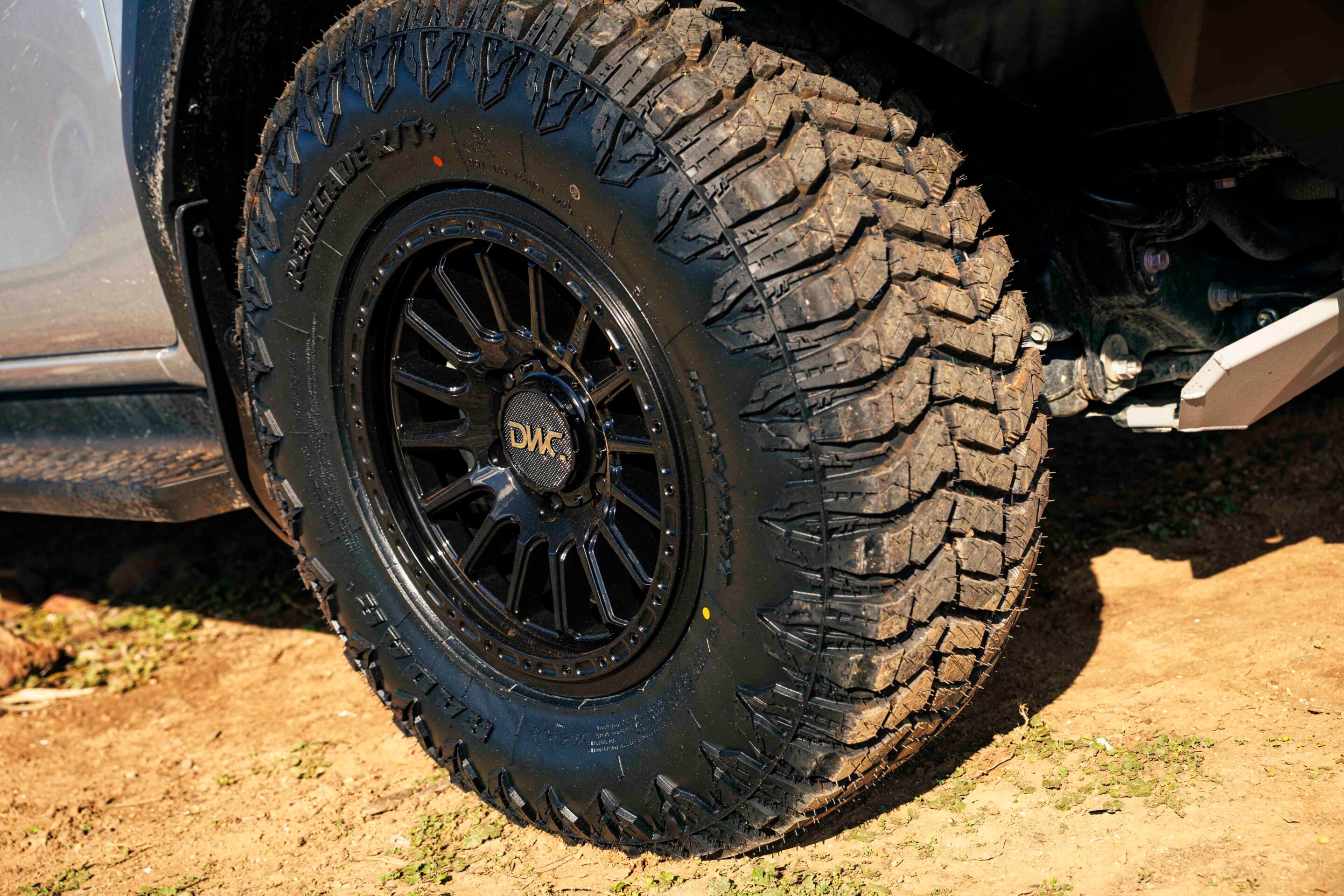
Short of venturing Stateside to source the wheels for your full-size pickup truck, Dynamic Wheel Co. (↗) has a huge range of wheel choices right here in Australia to suit all the major truck brands and all the popular four-wheel-drive vehicles.
Leading brands available from Dynamic Wheel Co. include Dirty Life, DWC, Raceline, Icon Alloys, Lock Offroad, Mayhem and Dynamic steel wheels, among others. They are available in diameters from 17 to 20 inches – and bigger if that’s your thing – and in a wide range of styles and finishes to suit your taste, all ready to fit your off-road tyres of choice.
As with any 4×4, replacement wheels for 1500-class pickup trucks need the correct fitment and load rating. GVM upgrades are popular for these trucks, and when choosing replacement wheels for your rig, you need to ensure their load ratings meet the requirements of the vehicle and any GVM upgrade.
This becomes more of an issue when you get into the heavy-duty 2500- and 3500-class trucks, with their higher load and towing capacities. Most of these HD trucks use eight-lug wheel fitments.
The 1500-class trucks tested here all use conventional six-lug wheels, so there are literally thousands of wheel options available for them, and Dynamic Wheel Co. (↗) has you covered.
While Dynamic Wheel Co. recommends 18-inch alloy wheels for full-size trucks fitted with tyres 35 inches or taller, larger-diameter rims can also work with tall tyres, provided the wheel-and-tyre package suits the vehicle and its suspension setup. A 20-inch wheel paired with a 37-inch tyre, for example, still leaves a decent amount of tyre sidewall, although clearance and fitment need to be checked.
If you’re not sure what you’re after, check out the massive selection on the Dynamic Wheel Co. website (↗) and talk with the team about what you want and what you need. They can help you choose a wheel package that not only looks killer on the truck but performs exceptionally as well.
Quickfire FAQs
What wheel brands does Dynamic Wheel Co. offer?
Brands include Dirty Life, DWC, Raceline, Icon Alloys, Lock Offroad, Mayhem and Dynamic steel wheels.
What wheel sizes are available?
The range includes wheels from 17 to 20 inches, with larger sizes also available.
What should you consider when choosing wheels for an American pickup truck?
Check wheel fitment and load ratings to ensure they suit the vehicle and any GVM upgrade.
Are alloy or steel wheels better for American trucks?
Both have their place, depending on your preferred style, intended use and load requirements.
What wheel size is recommended for full size trucks running 35 inch tyres or larger?
Dynamic Wheel Co. recommends 18 inch alloy wheels, although larger rims can also work if the wheel and tyre package suits the vehicle and suspension setup.
Ford Australia has recalled a total of 1085 Ranger and Everest vehicles over a manufacturing fault that could cause the centre screen to go blank, disabling the reversing camera.
The recall covers certain 2024, 2025 and 2026 vehicles equipped with a 10.1-inch centre display screen. If the screen stops working, the reversing camera image may not appear when the driver selects reverse gear, increasing the risk of an accident.
Ford will contact affected owners and ask them to arrange a free repair through an authorised Ford dealer. Owners can check whether their vehicle is affected by entering its vehicle identification number (VIN) on the Australian Government’s Vehicle Recalls website (↗). They can also contact an authorised Ford dealer or Ford Australia’s Customer Relationship Centre on 13 36 73.
Earlier this year, Ford recalled 2572 Ranger and Everest vehicles built between 2017 and 2019 over a transmission fault that could cause a loss of drive. The July 2026 recall extended an earlier campaign, with more than 2500 vehicles still requiring repairs.
In August, Ford also recalled 13,907 Ranger double-cabs built between November 2025 and July 2026 over B-pillar trim that could interfere with side curtain airbag deployment in a crash. The trim could also detach and injure occupants.
The Ford F-150 was also recalled earlier this month, with 3745 vehicles affected by a fault that could allow the fuel tank retaining strap to detach while driving. This could cause the tank to move or come loose, potentially leaking fuel and creating a fire risk.
Tesla has officially cancelled plans to bring the Cybertruck to Australia and New Zealand, with customers who placed deposits set to receive their money back.
After years of uncertainty surrounding the polarising electric ute, the decision is hardly a surprise. Tesla has notified reservation holders that the Cybertruck will not be offered in either market. Deposits will be refunded in full, with customers expected to receive their money within 30 days.
Tesla first opened Cybertruck reservations in 2019, taking refundable deposits of $150. The company stopped accepting new Australian reservations in 2022, but existing customers were left waiting for confirmation of whether the vehicle would ever reach local showrooms.
The Cybertruck is available in the US with dual-motor all-wheel drive and a more powerful three-motor Cyberbeast flagship. Tesla claims the Cyberbeast can accelerate from 0-100km/h in 2.7 seconds, while the dual-motor version offers a claimed range of up to 523km and towing capacity of 4990kg. These specifications apply to overseas models, with no Australian version planned.
While Cybertrucks have appeared in Australia for promotional events and public displays, a local launch never eventuated. The vehicle was developed for left-hand-drive markets, and bringing it here would have required significant engineering changes to meet Australian regulations.
As a sweetener, Tesla is offering affected customers a free 12-month subscription to its Full Self Driving (Supervised) software if they purchase a new Model 3 or Model Y. The subscription is valued at $1788.
The decision ends Australian and New Zealand Cybertruck reservations, with no local release planned.
Honda will launch a Mitsubishi Triton-based ute in ASEAN markets in 2028, marking its first entry into the region’s ute market under a new vehicle supply agreement with Mitsubishi Motors.
The Honda ute will follow the Nissan Navara in using the Triton as its basis. The latest Navara shares the Triton’s underlying platform and diesel powertrain, but features Nissan-specific styling and suspension developed and tuned by Australian engineering specialist Premcar. Honda has yet to detail how its version will differ from the Mitsubishi.
The current Australian Triton is powered by a 2.4-litre four-cylinder bi-turbo diesel engine producing 150kW and 470Nm. It is available with a six-speed manual or automatic transmission, with rear-wheel drive and four-wheel drive configurations offered depending on variant. Australian models have a maximum braked towing capacity of 3500kg.
The agreement is intended to benefit both manufacturers, with Honda able to expand its lineup without developing an entirely new ute, while Mitsubishi Motors expects the arrangement to increase production volumes and improve capacity utilisation at its Thai manufacturing plant.
The ASEAN market comprises 11 Southeast Asian countries: Brunei, Cambodia, Indonesia, Laos, Malaysia, Myanmar, the Philippines, Singapore, Thailand, Timor-Leste and Vietnam. The region is an important market for one-tonne utes, with the Mitsubishi Triton already sold across several countries.
The collaboration follows a strategic partnership agreement signed in August 2024 between Honda, Mitsubishi Motors and Nissan. The three companies have been exploring opportunities to share vehicles and other resources to improve efficiency and respond to market demand.
The Honda-badged Triton is scheduled to go on sale in ASEAN markets in 2028. The manufacturers have not announced plans to introduce the model in Australia.
Platform-sharing FAQs
Why do brands platform-share?
To reduce development costs, speed up production and share manufacturing expenses while retaining brand-specific styling and tuning.
What other utes share platforms?
The Ford Ranger and VW Amarok share an architecture, while the Mazda BT-50 is based on the Isuzu D-MAX. The Nissan Navara shares its underpinnings with the Mitsubishi Triton.
Is platform sharing the same as rebadging?
No. Rebadging usually involves selling essentially the same vehicle under another name, while platform sharing allows brands to develop distinct models using common architecture and components.
Will the Honda Triton-based ute come to Australia?
No Australian launch has been confirmed. Honda has announced ASEAN sales from 2028 only.
Chery is getting ready to throw its hat into Australia’s crowded 4×4 ute market with the Stockman, a diesel hybrid that looks to have a few tricks up its sleeve.
With 350kW, 800Nm, front and rear diff locks, a locking centre differential and 3495kg of towing capacity, the Stockman isn’t short on numbers. It also gets more than 247mm of ground clearance and a 34kWh battery, with Chery claiming up to 96km of electric driving range on the WLTP cycle.
There’s more to the Stockman than what’s on the spec sheet, too. Chery has brought in Australian engineering outfit Premcar to help tune the ute for local roads and conditions, while Ironman 4×4 is developing a range of accessories for owners looking to set theirs up for touring and off road use.
Reservations opened in October 2026, with deliveries due to kick off on February 1, 2027. There’s still plenty we don’t know, including final Australian pricing, but the Stockman is shaping up as an interesting new option for anyone shopping for a dual cab with a bit more going on under the skin.
Here’s everything we know about it!
JUMP AHEAD
- Oct 2026: Ironman 4×4 loads up Stockman with off-road gear
- Oct 2026: Aussie specs confirmed
- Oct 2026: Reservations open ahead of February 2027 arrival
- Aug 2026: Premcar to tune Stockman for Australian conditions
- July 2026: More details revealed
- June 2026: Chery confirms name after public vote
- May 2026: Final names shortlisted from public submissions
- March 2026: Utey McUteface? Australians get to name it
- Feb 2026: Chery KP31 Concept unveiled as world’s first PHEV diesel ute
October 2026: Ironman 4×4 loads up Stockman with off-road gear
Chery has partnered with Australian owned Ironman 4×4 to offer a range of accessories for the Stockman, available to order through Chery dealerships. The line up covers the usual touring and off road upgrades, including an aluminium bull bar, steel side steps, roof rack, canopy, roller drawers, tow bar and suspension lift.
The APEX bull bar includes a 12,000lb winch cradle, rated recovery points and a 4mm front skid plate, while the Raid canopy offers solid or glass doors and optional central locking. Ironman’s IM2.5 suspension kit provides a 50mm lift front and rear, with spring options for constant loads of 200kg or 300kg.
The accessories have been adapted and tested for the Stockman, with relevant components using 5052 aluminium alloy. Ironman 4×4 will also match Chery’s seven year manufacturer warranty on accessories ordered with the ute, while a federally approved GVM upgrade with increased axle load ratings is expected to follow after launch.
October 2026: Aussie specs confirmed
Chery confirmed Australian specifications for the Stockman in October 2026, revealing a 2.5 litre turbo diesel plug in hybrid powertrain producing a combined 350kW and 800Nm. A 34kWh battery provides a claimed electric driving range of up to 96km on the WLTP cycle, while an 80 litre fuel tank adds touring range.
The Stockman will have all wheel drive, front, centre and rear diff locks, more than 247mm of ground clearance and all terrain tyres. Towing capacity is rated at 3495kg braked and 750kg unbraked, with double wishbone front suspension and leaf springs at the rear.
Inside, Chery confirmed a 10.25 inch digital instrument cluster, a 15.6 inch infotainment touchscreen and a 14 speaker audio system, along with a suite of driver assistance technology.
Chery also released an indicative specification sheet detailing features including low range, selectable terrain modes, crawl control and tight turn assist. Some figures, including GVM, GCM and kerb weight, remain indicative and could change before the Stockman reaches Australian showrooms.
October 2026: Reservations open ahead of February 2027 arrival
Chery opened online reservations for the Stockman on October 1, 2026, ahead of customer deliveries scheduled to begin on February 1, 2027.
Early customers who reserve the ute online can receive a $2000 Bunnings gift card and three years or 45,000km of complimentary scheduled servicing. The offer applies until official sales commence, subject to terms and conditions. Chery has yet to announce Australian pricing or final model grades, with further details expected closer to the Stockman’s showroom arrival.
August 2026: Premcar to tune Stockman for Australian conditions
Chery has enlisted Australian engineering outfit Premcar to test and validate the Stockman’s ride and handling ahead of its local launch. The Melbourne based company has almost 30 years of experience developing vehicles for Australian conditions, including Nissan’s Warrior models and the Mitsubishi Triton Raider.
Rather than starting from scratch, Premcar will assess Chery’s existing suspension and ride and handling calibration across a range of local conditions. That means testing how the Stockman deals with everything from urban streets and highways to construction sites and remote off road tracks.
July 2026: More details revealed
Chery revealed more details of its upcoming Stockman in July 2026, confirming a 2.5 litre turbo diesel powertrain producing a claimed 350kW and 800Nm. The system combines diesel power with electric assistance, with claimed fuel consumption of 2.0L/100km and up to 100km of electric only driving range on the NEDC cycle.
The Stockman will offer 3500kg of braked towing capacity and 750kg unbraked, alongside four wheel drive, front, centre and rear diff locks, crawl control and tight turn assist. Ground clearance is rated at 247mm, with all terrain tyres and double wishbone front suspension paired with leaf springs at the rear.
Measuring 5450mm long, 2010mm wide and 1890mm tall, the Stockman has a 3250mm wheelbase and a 1560mm by 1560mm cargo tub. Inside, it will feature leather upholstery, heated and ventilated front seats, wireless charging, dual zone climate control and premium audio.
Chery also confirmed that the Stockman’s suspension and driver assistance systems would be tuned for Australian conditions. A petrol plug in hybrid version was planned to join the range in 2027, with Australian pricing and model grades still to be announced at the time.
June 2026: Chery confirms name after public vote
Chery has confirmed its new diesel plug in hybrid ute will be called the Stockman, following a nationwide naming competition that attracted more than 20,000 entries. The winning name received more than 25 per cent of the public vote, with more than 12,000 Australians taking part in the final round.
The winning entry came from Victorian Steve Kodikara, who will receive the first Stockman to arrive in Australia. He chose the name for its connection to Australia’s stockmen, representing the reliability, toughness and ability to handle challenging terrain expected of a working ute.
Stockman beat finalists including Outrider, Orca, Ironbark, Bushwalker, Longreach, Ridgeback, Terra and Mate. The name also has some history in Australia, having previously been used by Suzuki for a work focused version of the Sierra in the 1990s.
The Stockman will be Chery Australia’s first ute and is set to combine diesel power with plug in hybrid technology. Further details, including pricing and final specifications, were still to be confirmed when the name was announced in June 2026.
May 2026: Final names shortlisted from public submissions
Chery has shortlisted nine names for its upcoming plug in hybrid diesel ute after receiving more than 20,000 entries in a nationwide naming competition. The shortlist includes Outrider, Orca, Ironbark, Bushwalker, Stockman, Longreach, Ridgeback, Terra and Mate.
The names draw on themes of Australian outback heritage, toughness and off road capability, with entrants asked to explain why their suggestion suited the new dual cab. Some took a more playful approach, with Dropbear and B Ute among the entries that didn’t make the final cut.
The ute is expected to arrive in Australian showrooms later in 2026, with a diesel electric plug in hybrid powertrain, 1000kg payload and 3500kg braked towing capacity.
Public voting opened on May 5 and closed on May 19, 2026, with the winning name to be announced ahead of the ute’s local launch. The person behind the successful entry will receive the first example to arrive in Australia
March 2026: Utey McUteface? Australians get to name Chery’s world-first plug-in hybrid diesel ute
Chery invited Australians to name its upcoming plug in hybrid diesel ute ahead of its local launch, with the winner set to take home the first example to arrive in the country. The competition opened on March 12, 2026, with entrants asked to suggest a name and explain why it suited the new dual cab.
The ute was then known by its internal code, KP31, and was billed as the world’s first plug in hybrid diesel ute. Chery said it was being developed with Australian buyers in mind, targeting a 1000kg payload and 3.5 tonne braked towing capacity.
Entries were reviewed by Chery, with a shortlist progressing to a public vote to decide the final name. The competition closed on March 26, with the winning entrant to receive the ute when it arrived in Australia later in the year.
February 2026: Chery KP31 Concept unveiled as world’s first PHEV diesel ute
Chery unveiled the KP31 concept in February 2026, previewing a production dual cab ute due in the fourth quarter of the year.
It pairs a 2.5 litre turbo diesel with electric assistance, with claimed thermal efficiency of 47 per cent and 10 per cent better fuel economy than a typical diesel powertrain. Payload is rated at 1000kg, with 3.5 tonnes of towing capacity.
The concept features a squared off body, upright headlights, a snorkel, 285/70 R17 all terrain tyres and a tub rack carrying recovery tracks. It measures 5610mm long, although the production model is expected to be shorter at 5450mm.
Chery also claimed the diesel hybrid powertrain would reduce vibration by 30 per cent compared with conventional diesel engines. The KP31 concept was finished in matte grey, with prominent Chery badging and a practical rear bumper step. A petrol plug in hybrid variant is also planned for 2027, expanding the range beyond the diesel hybrid model.
Everyone knows that, without a little preparation, corrugations can shake every nut and bolt in a car loose.
It’s basically like hitting your entire vehicle’s nut and bolt catalogue with a very small rattle gun, then repeating it a few thousand times over hundreds of kilometres of corrugations. Small, jarring impacts can eventually vibrate even the tightest of nuts and bolts out of their torque setting. Obviously, this is far from ideal, and something needs to be done before leaving.
Where fasteners come loose
To be fair, most vehicles leave the factory with some sort of thread-locking compound applied to the bolts in areas prone to rattling loose.
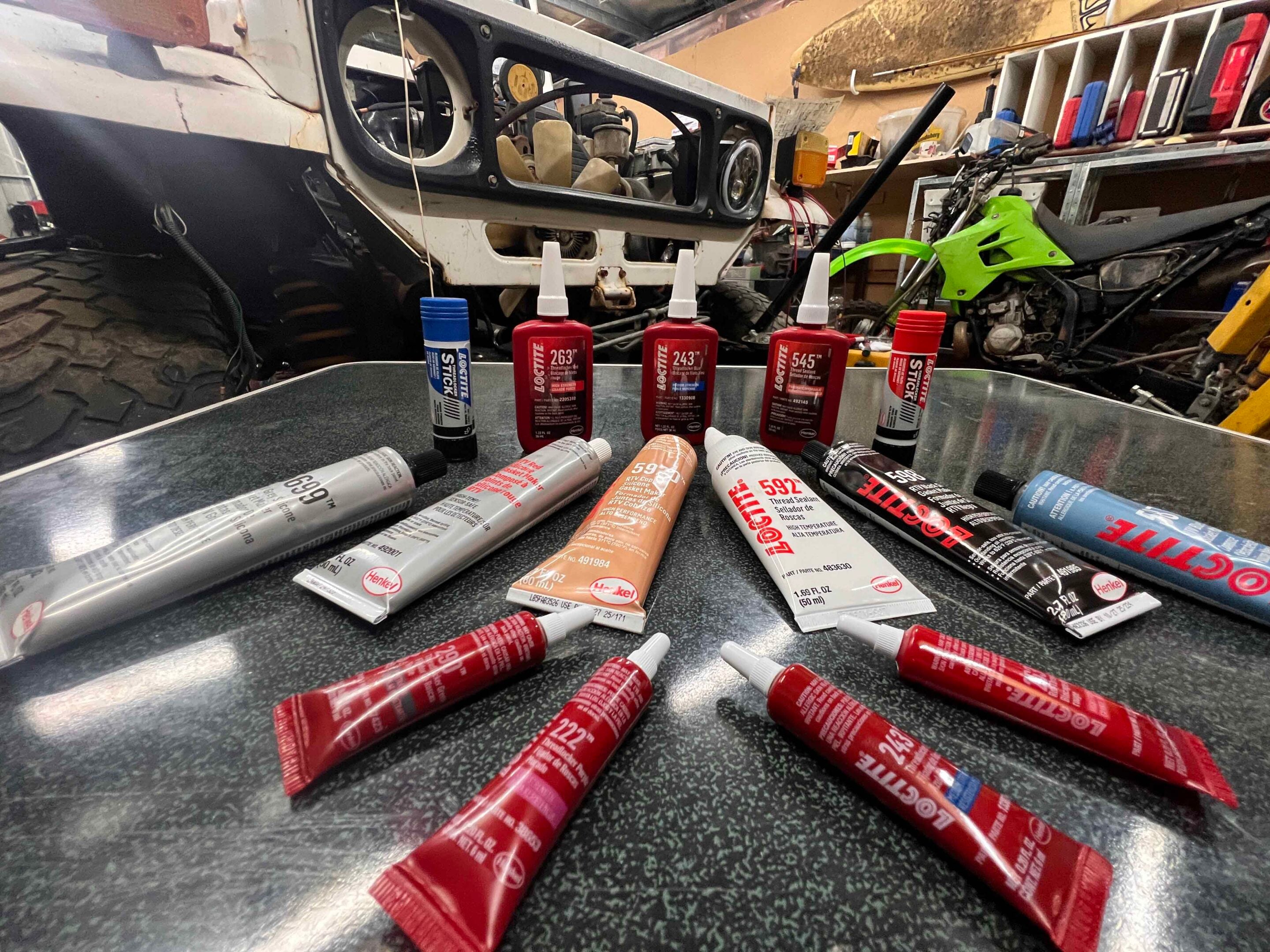
However, when most of us bolt on accessories, we often neglect to use Loctite (↗) or rely on nuts with a nylon locking collar. They work great until you have to undo the nut. Once it’s retightened, the locking collar can lose part of its original prevailing torque. We’re talking things like roof racks, bar work, snorkels, mounting brackets and canopies. If it bolts onto your rig, it can be vibrated off. At least, it can without prior treatment of the fasteners.
What happens when fasteners loosen
As mentioned, corrugations act as a jarring force over many kilometres.
This can loosen fasteners to the point where the accessory can move around, damaging whatever it’s mounted to or even coming free altogether. We’re sure we don’t need to paint you a picture of what can happen if a slider or roof rack breaks free when navigating a bend in the track at speed. Let’s just say that minor vehicle damage is the best-case scenario. Serious injury (or worse) can and does occur.
How to prevent fasteners coming loose
You’re likely going to service your rig before a decent-sized trip anyway. It’s good practice and allows you to give everything an eyeballing before heading somewhere that roadside assistance has never even heard of, let alone will come to help you out.
While you’re under your 4×4, give your accessories the once-over with a spanner or socket. If you’re unsure whether thread-locking compound has been applied, it’s a great opportunity to undo the fastener and apply some. It’ll take you an hour or so to do the whole vehicle, but it sure beats fishing your lightbar out of a croc-infested river.
Application is easy. A couple of drops is all you need on the thread of the bolt where the nut is going to be tightened. If you’re bolting something into a blind hole, put a couple of drops into the hole on the thread near the bottom. The liquid is forced upwards through the action of tightening the bolt, so this will avoid pushing it out of the hole before the proper torque has been reached.
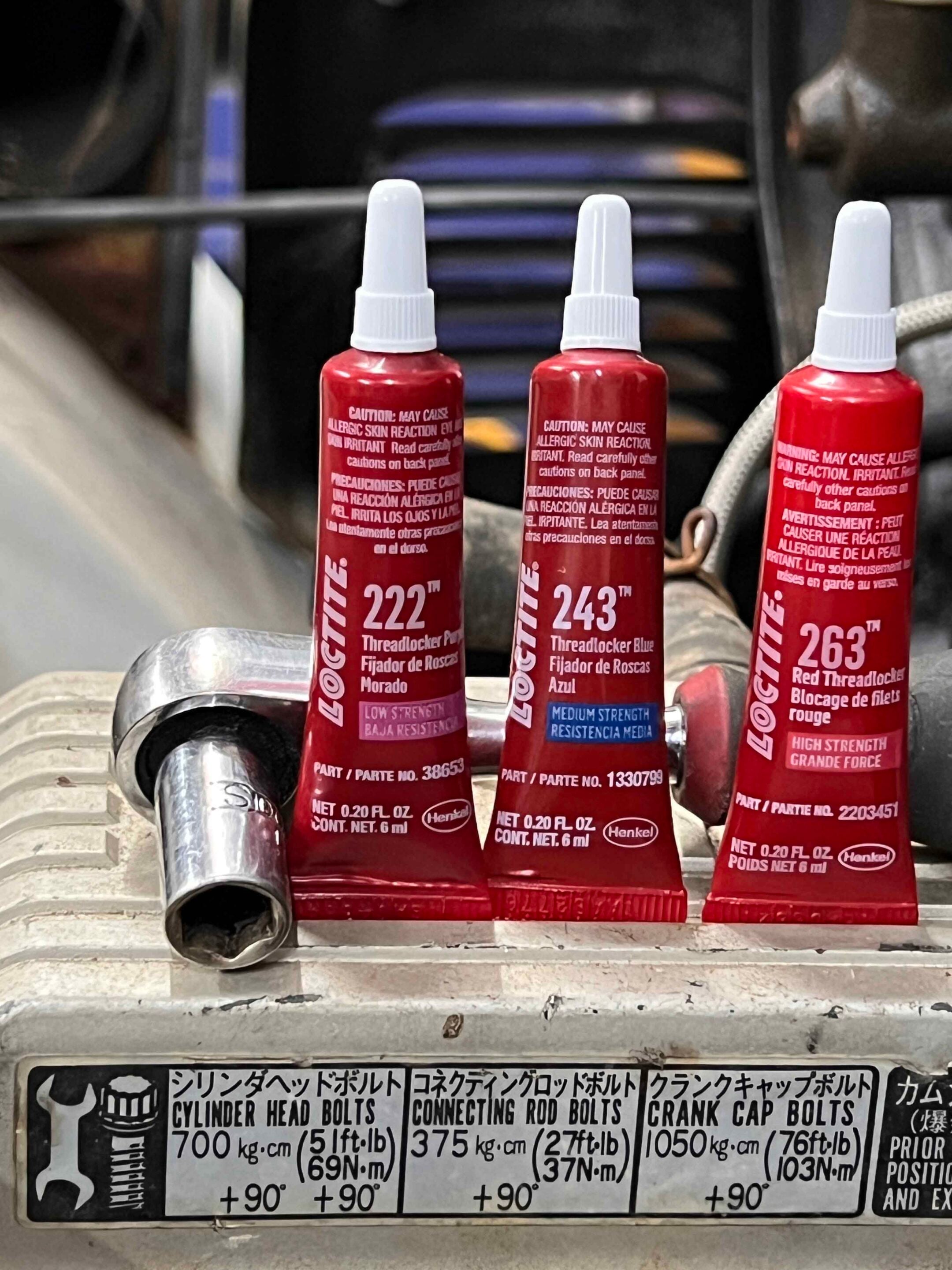
Once the fasteners have been torqued, the lack of air will allow the Loctite (↗) to cure and form a solid plastic-like material, which will prevent the fastener from rattling loose. Don’t be fooled by the ‘medium-strength’ thing either. High-strength is not always better. The medium-strength blue Loctite is the go when attaching UHF aerial brackets, driving lights, canopies, recovery board mounts, roof racks, awnings and most accessories. If you ever do need to remove such accessories, a quick crack of the ratchet or a hit with the impact gun will simply turn the hardened plastic to dust, and you can easily undo the fastener.
Red high-strength Loctite is more for stuff that should never need undoing, like bull bars or sliders. If they do need removing, heat via an induction tool may have to be applied to soften the Loctite before removal while hot.
Why threadlocker is worth using
You could be forgiven for thinking that tightening things to their torque spec is enough, and for 95 per cent of driving, you’re correct.
However, when hitting off-road obstacles (corrugations being the worst), it really is only a matter of time before things shake loose. There are, of course, alternatives to thread-locking compounds, such as Nylock nuts and Nord-Lock washers. Both have their place, but both have their downsides and are considerably more expensive than a simple bottle of Loctite. On top of that, your Loctite can be used multiple times, whereas the others will only ever suit a single application.
If a better solution ever pops up, it’ll probably be invented by Loctite (↗) anyway. Until then, having a bottle on hand is one of the cheapest forms of insurance and preventative maintenance money can buy.
Chery has unveiled an off-road-focused version of its Tiggo 7 SUV, dubbed the Tiggo X7, with tougher styling and a range of features aimed at improving its ability away from sealed roads. But does it have the hardware to match its looks?
Revealed at the 2026 Chery International User Summit in Wuhu, China, the Tiggo X7 is the first in a new family of Tiggo X models. The off-road version gets increased ground clearance, chunky all-terrain tyres and six terrain-specific driving modes. These include settings for snow, mud, sand, rocks and water wading, although the sixth mode has not been detailed.
Those features could help on gravel roads and easier bush tracks, but tackling the Simpson Desert, rocky tracks in the Victorian High Country or muddy trails in North Queensland takes more than terrain modes and a rugged body kit.
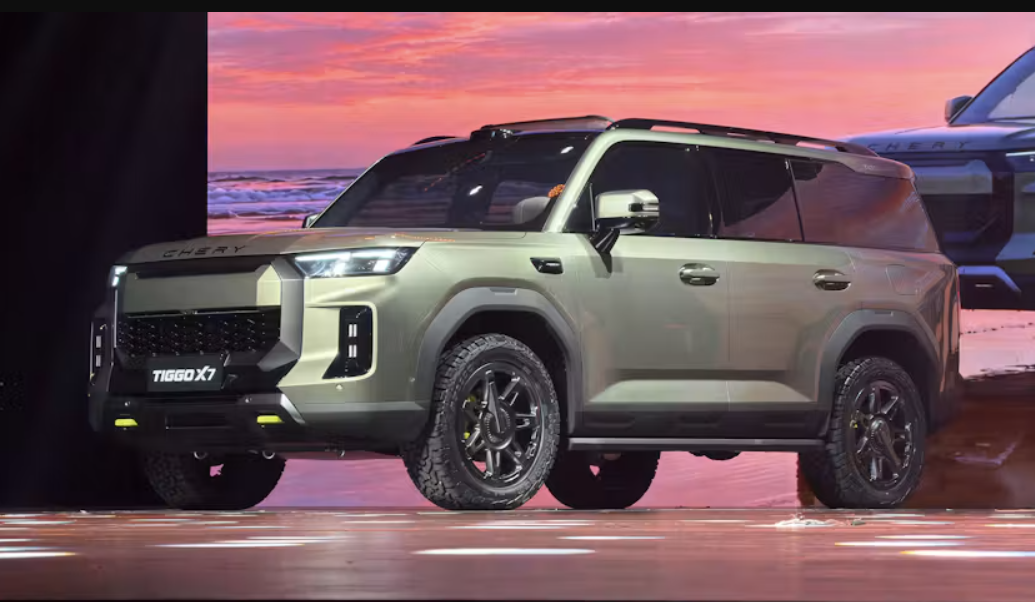
Chery has yet to confirm whether the Tiggo X7 will have all-wheel drive or a proper four-wheel-drive system with low-range gearing. Differential locks, underbody protection and approach, departure and ramp-over angles also remain unconfirmed.
Its reported maximum towing capacity of 1500kg is modest compared with traditional off-road wagons, many of which can tow up to 3500kg. Australian-market specifications have not been confirmed.
The exterior features a squarer front end, prominent wheel-arch cladding and C-shaped rear LED tail-lights. The bumpers also feature trim designed to mimic recovery points, although their functionality has not been confirmed. Inside, the Tiggo X7 shares a layout with the updated Tiggo 7, including a landscape-oriented central touchscreen and digital instrument cluster.
Chery has not confirmed Australian availability, pricing or a local launch date.
Chery Tiggo X7 quickfire FAQs
What is the Chery Tiggo X7?
An off-road-focused version of the Tiggo 7 SUV and the first model in a new Tiggo X family.
Does the Chery Tiggo X7 even have four-wheel drive?
Chery has yet to confirm its drivetrain or whether it will feature low-range gearing.
What off-road features does the Tiggo X7 have?
It gets increased ground clearance, all-terrain tyres and six terrain modes, including settings for mud, sand and rocks.
How much can the Chery Tiggo X7 tow?
Its reported maximum towing capacity is just 1500kg.
Will the Chery Tiggo X7 come to Australia?
An Australian launch has not been confirmed.